


 【关注川源科技HiCY】
-

 服务热线 400-700-2017
服务热线 400-700-2017
服务热线 400-700-2017
搜索更多信息



We are committed to solving the problems of inaccurate detection of new material expansion characteristics caused by large friction and slow response in traditional methods, and realizing rapid and synchronous detection of in-situ expansion thickness, mechanical parameters and electrochemical behavior of the pole piece
Application Areas

·Positive and negative electrode material screening
Quantify the irreversible expansion rate of different materials and select materials with better volume stability
·Pole parameter optimization
Detecting the correlation between coating thickness distribution and swelling
High-precision thickness monitoring |
Zero friction in-situ expansion fixture |
Flexible multi-channel |
Single-layer pole piece in-situ monitoring |
No delay detection |
Fully sealed test environment |
Projects Item | Traditional Solution | HiCY Solutions | ||
/ | Coin E1 | Stack XX | ||
Traditional piston simulation fixture | Zero friction accordion type buckle fixture | Single-sided laminated battery module | ||
Application Areas | Evaluation of rapid expansion level of materials (electrodes) | |||
Recommendation index | Not recommended | ★★★★★ | ★★★ | |
How it works | O-ring seal piston guide rod displacement detection | Accordion seal guide rod displacement detection | The soft packaging is connected to the displacement sensor | |
Core Differences | The piston guide seal has large friction, and the thickness detection response is slow and the accuracy is low. | Zero friction, fast displacement monitoring response and high accuracy | Cell-level analog structure, long assembly preparation cycle, low efficiency | |
Expansion thickness detection | Range | / | 0-10mm | / |
Accuracy | / | ±0.1μmor±1μm | / | |
Resolution | / | 0.01μmor0.1μm | / | |
Evaluation efficiency | High | Low | ||
Applicable test items | Cyclic capacity test | Cycle, rate, lithium deposition and other tests | ||
Connected system | In-situ expansion force test system, stand-alone use | |||
Data synchronization | Bias exists | synchronous | synchronous | |
The evaluation of battery expansion is very important in the research and development of battery materials. At present, it is mainly used to evaluate the battery cells with multi-layer pole pieces, which can no longer meet the demand for rapid expansion evaluation of new materials such as silicon negative electrodes in the lithium battery industry.
·Pole piece in-situ expansion test can more directly evaluate the strength and elastic parameters of materials and pole pieces.
·Provide a new method for scientific researchers to quickly evaluate the expansion characteristics of materials;
·Provide support for engineers in battery cell development, structural design, process optimization and related mechanism research
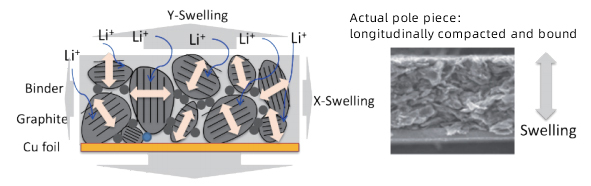
·The full-battery in-situ expansion test system is based on a zero-friction in-situ buckle fixture, integrating high-precision displacement, voltage, current, temperature and humidity core sensors to achieve rapid detection of full-battery thickness changes.
·The single-layer pole piece in-situ expansion test system is based on an accordion-type in-situ buckle fixture. The hard diaphragm is fixed by the inner cavity mold design, and a high-precision sensor is combined to directly monitor the dynamic expansion of the single-layer pole piece during the charge and discharge process.
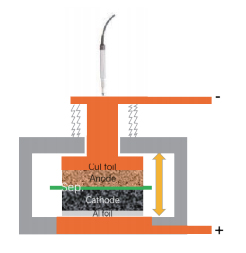 (a) Zero friction accordion-style clamping fixture | 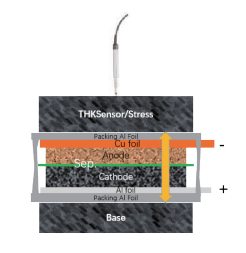 (b) Single-layer laminated battery module |
High-precision thickness monitoring Resolution 0.01um, accuracy ±0.1μm Supports in-situ dynamic tracking of the microscopic deformation and expansion trend of the pole piece | Fully sealed test environment Excellent sealing ensures long-term stable testing Accurately reflects the expansion characteristics of single-layer electrodes under real electrochemical conditions | Single-layer pole piece in-situ monitoring Dynamic in situ measurement of the expansion behavior of a single-layer electrode to independently quantify the volume change of a single active material | Zero friction dynamic detection The accordion-style clip-on fixture design eliminates the sealing friction interference of the traditional piston rod |
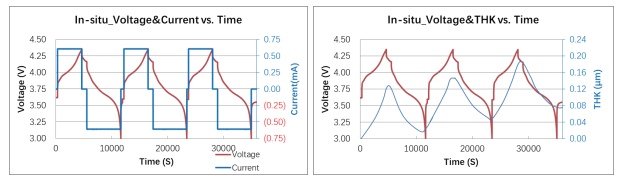
1. Evaluation of in-situ expansion of buckled electricity |
·During the charging process, as NCM de-lithiation and Li metal intercalation occur, the overall thickness expands and grows;
·During the discharge process, the thickness decreases after Li metal de-lithiation, but the thickness increases due to the overall irreversible reaction.
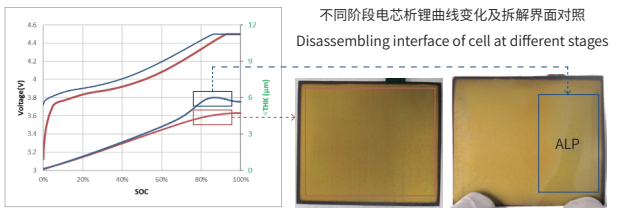
2. Non-destructive lithium analysis of single-layer stacking |
·Analyze the changes in battery expansion thickness at different SOCs, effectively predict the location and possibility of lithium plating, and avoid the risk of lithium plating during battery design.
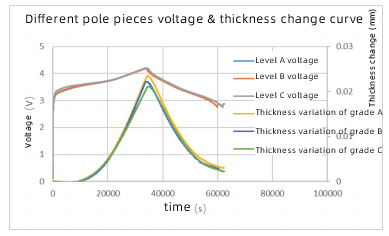
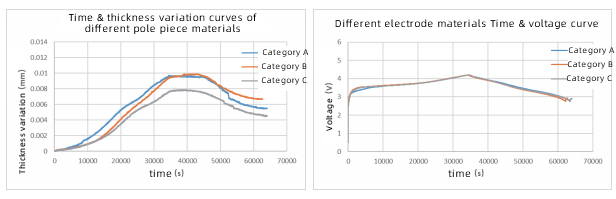
3. Evaluation of different pole piece materials |
·Pole expansion during formation: C<A<B
·Evaluate the expansion behavior of different pole piece materials during the charge and discharge process.
4. Evaluation of single-layer pole piece thickness change |
· Negative electrode expansion: C<B<A
· Evaluate the expansion behavior of a single-layer electrode during charging and discharging