




 【关注川源科技HiCY】
-

 服务热线 400-700-2017
服务热线 400-700-2017
服务热线 400-700-2017
搜索更多信息



We are committed to solving the limitations of traditional solutions in terms of poor real-time performance, low accuracy, non-storable data and destructive measurement, and achieving real-time non-destructive dynamic monitoring of the internal expansion force distribution of the battery
Application Areas

·Battery cell design and process optimization
·Battery cycle life and safety testing
·Formation process quality control
·Locate manufacturing process defects
High stability and sensitivity |
High-density flexible sensing technology |
Real-time and high precision |
Cost saving and environmental protection |
Environmental adaptability |
Strong flexibility |
Compare Projects | Low-density sensor array solution | High-density flexible sensor solution | |
Solution Model | PDA-11 | PDA-1N | |
Key Features | Simulation of hard expansion force
| Simulate expansion force within the module
| |
Actual effect display | |||
Number of channels | ≥6CH | ≥1CH | |
Main parameters | Range | 0-300kg/~40MPa | 4MPa |
Accuracy | ±0.5%F.S. | <5%F.S. | |
Drift | 0.3%F.S. | <5% per Logtime | |
Operating temperature | -40°C~85°C | ||
Sensor reliability | Longer periodic calibration | Shorter period of regular calibration required | |
Data acquisition module | Independent function, no need to use a computer | Need to configure the computer and host computer | |
Software | Expandable host computer | Expandable host computer | |
Compatible charging and discharging equipment | Can be adapted to Xinwei and other charging and discharging machines | Independent of charging and discharging equipment, data integration | |
Sensor Category | Traditional micro weighing | New flexible film | |
During the charge and discharge process of the battery, the volume of the electrode active material changes periodically due to the insertion/extraction of lithium ions in the electrode material, resulting in expansion force in the battery cell as a whole or in part. In-situ expansion force distribution refers to the real-time monitoring of the pressure distribution state at different locations inside the battery cell through high-precision sensors, reflecting the spatial differences and dynamic changes of the expansion force.
·The in-situ expansion force distribution of the battery is detected by a thin film flexible sensor array based on the principles of piezoresistance, piezoelectricity or ionization.
·The thin film sensing sheet is composed of two layers of flexible and bendable thin film materials, the upper layer is a pressure-sensitive functional film, and the lower layer is an electrode. When the thin film sensing sheet is pressurized, the upper and lower layers of the film come into contact, and their contact area and contact deformation will change with the pressure, so that the electrode end will produce a change in the amount of electrical impedance signal generated by the pressure change.

High-density flexible sensing technology Dense sensor points (up to 2000 points/cm2) Can accurately capture pressure changes in tiny areas | Real-time and high precision The data acquisition speed reaches 20us, supporting real-time monitoring of dynamic charging and discharging process, and synchronously outputting pressure distribution heat map | Digital management of the entire life cycle Supports more than 20,000 cycle tests Real-time data storage and playback Compatible with a variety of charging and discharging equipment | Environmental adaptability Operating temperature range -40°C~85°C Meet the testing requirements of extreme working conditions |
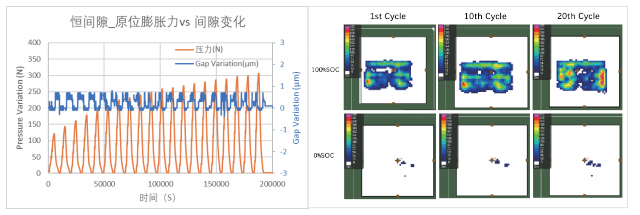
1. Distribution of expansion force of battery cells at different SOC ·The overall expansion force continues to increase as the cycle progresses; ·Study the expansion force distribution and gap change law of the battery cell under different charging states, and evaluate its structural stability during the charge and discharge cycle.
| 2. Application of Formation and Formation Pressure Detection ·Comparison between the formation and pressing of consumer batteries and pressure-sensitive paper shows that uneven force is applied during the battery cycle. At the same time, the formation equipment ·Uneven clamping force occurs between the clamps;
|