


 【关注川源科技HiCY】
-

 服务热线 400-700-2017
服务热线 400-700-2017
服务热线 400-700-2017
搜索更多信息



We are committed to solving the limitations of traditional solutions in terms of poor real-time performance, low accuracy, non-storable data and destructive measurement, and achieving real-time non-destructive dynamic monitoring of the internal expansion force distribution of the battery
Application Areas

·One-stop thickness, voltage internal resistance and compression
·Battery production quality control and consistency verification
·Battery cell cycle life and safety assessment
·Battery manufacturing and quality control
Functional integration |
Moving speed and pressure are adjustable |
High-precision measurement |
The maximum efficiency can reach 10ppm |
Multiple measurement modes |
New intelligent fully closed-loop control system |
Model | PPG20 | PPG20A | T20A | T20R | |
Thickness closed loop | ● | ● | ● | ● | |
Pressure closed loop | x | ● | ● | ● | |
Automatic injection | X | ● | ● | ● | |
Test efficiency | ≥6ppm | ≤3ppm | |||
Compatible batteries | Cell Type | Soft bag/square | |||
Compatible size | 120*100*50mm | 250*100*50mm | 800*400*100mm | ||
Pressure Modules | Pressure control mode | Weights | Cylinder drive | ||
Pressure control range | 0.2~2kg | 15~500/30~1000kg or suitable | |||
Pressure detection accuracy | ≤5% | 0.3%F.S. | |||
Thickness module | Measuring range | 0~50mm | 0~100mm | ||
Accuracy | ±10μm or adaptable | ±30μm or adaptable | |||
Instrument size | 255*274*500mm | 900*650*1500mm | |||
Instrument weight | 15kg | 25kg | 160kg | 220kg | |
The thickness of the battery directly affects the performance and stability of the battery. During the production process, measuring the battery thickness can ensure that the battery size meets the specifications, and it can also check whether there are bad battery components or manufacturing process defects. In research and development, by testing the battery thickness, we can better understand and analyze the internal structure and material composition of the battery, and then make corresponding optimizations and improvements.
Current pain points of battery thickness measurement |
Using traditional pneumatic and traditional servo electric cylinders → pressure overload, instantaneous impact force is too large → different thickness requirements or sample thickness deviations lead to instantaneous pressure overload or too long test time
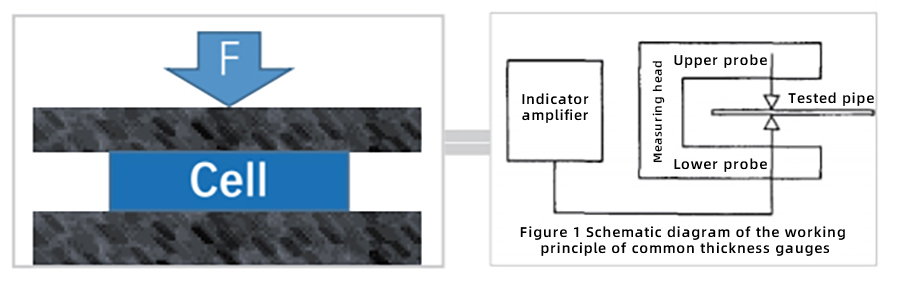
· Pressurized contact: During measurement, the cylinder applies constant pressure to the surface of the battery cell, so that the probe is in close contact with the upper and lower surfaces of the battery cell.
·Thickness measurement: The micrometers at both ends measure the distance between the probes under pressure, which is the compressed thickness of the battery cell.
Measurement Mode

·The test system realizes the following functions (similar to battery charging and discharging, CC+CV mode, Step Charge mode);
·Load pressure at different rates to the target pressure, keep the target pressure for a certain time, record the corresponding information, and complete the test;

Safety without overload A new generation of intelligent fully closed-loop control system developed independently Industry leading companies promote products | All-in-one An integrated single input control window for the complete device Avoids complex operations between different interfaces, and makes control simple | Intelligent and adjustable Using intelligent pneumatic control, the moving speed and pressure can be adjusted and set Measurement can achieve dynamic pressure holding function | High efficiency 6ppm The highest measurement accuracy reaches ±0.01mm Minimum resolution 0.5um |
1. In-situ static thickness analysis of battery cells |
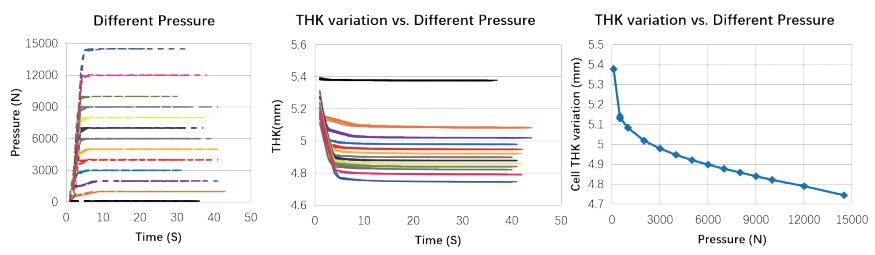
·The thickness decreases rapidly in the initial pressure stage, then tends to be flat, and the thickness remains almost unchanged under steady-state pressure;
·Study the mechanical deformation characteristics of the battery cell under static pressure, understand the law of its thickness change with pressure, and guide the setting of pressure parameters in battery design and manufacturing.
2. Cell Thickness Assessment |
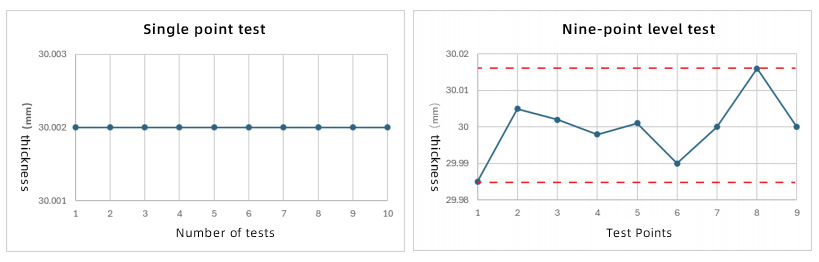
·The cell thickness fluctuation of single point test is within 0.002mm, and the fluctuation of nine-point horizontal test is within ±0.015mm.
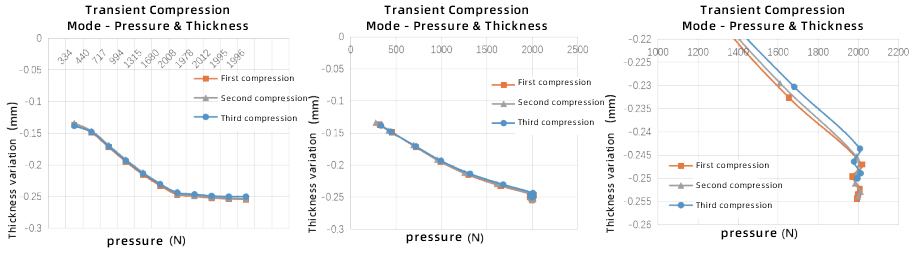
3. Transient compression modulus |
·In the transient compression mode of the battery cell, the thickness gradually decreases as the pressure increases, and the thickness change gradually decreases after multiple compressions;
·Provides performance data of the battery cell under high load, and can analyze the deformation behavior of the battery cell in extreme environments.
4. Steady-state compression modulus |
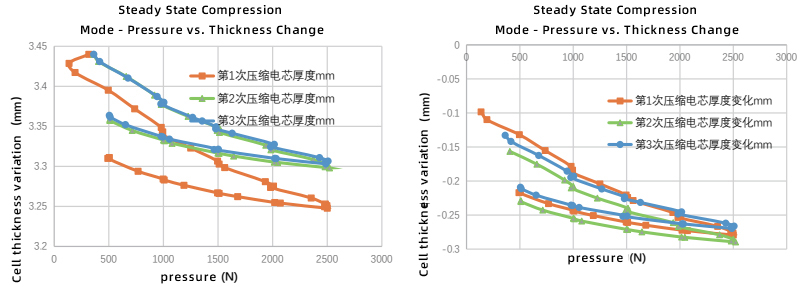
·In the stable compression mode of the battery cell, the thickness gradually decreases as the pressure increases, and the thickness change gradually decreases after the first compression;
·After the test, the three stable compression deformation ratios of the battery cell are 84.1μm, 30.2μm, and 23.6μm;