


 【关注川源科技HiCY】
-

 服务热线 400-700-2017
服务热线 400-700-2017
服务热线 400-700-2017
搜索更多信息



We are committed to solving the problem that traditional methods rely on complex physical and chemical parameters and cannot meet the needs of industrial real-time detection, and realize rapid and accurate detection of the overall resistance, resistance distribution and coating consistency of the electrode
Application Areas

·Electrode formula development
Conductive agent, positive and negative electrode materials, cross-linking agent,Evaluation of process design such as cold pressing
·Coating diaphragm development
Evaluation of process design such as slurry formula and coating
·Production stability monitoring
New multi-probe measurement |
Pole piece overall resistance measurement |
One-stop measurement of multiple parameters |
Pole A/B side resistance breakdown |
Exclusive PCT patent technology |
Double-sided coating consistency |
Device Model | Regular Edition | Decomposed version | Integrated machine | |||||||||
G2 | G2A | G2R | Magic 3 | Magic 3A | Magic 3R | Magic One | ||||||
Test Principle | Four-wire two-probe method | Multi-probe method | ||||||||||
Measurement functions | Overall resistance | ● | ● | ● | ||||||||
A surface resistance | X | ● | ◎ | |||||||||
B side resistance | X | ● | ◎ | |||||||||
Compacted density | ◎(Input weight) | ◎(Input weight) | ● | |||||||||
Area Density | ◎(Input weight) | ◎(Input weight) | ● | |||||||||
Short circuit inside the pole piece | Composite current collector and internal short circuit of pole piece | |||||||||||
Test subjects | Electrode, carbon-coated aluminum foil, primer substrate, etc. | |||||||||||
Pressure control | Range Voltage regulation method Loading rate | 0-35MPa | ||||||||||
Manual | automatic | Manual | automatic | automatic | ||||||||
Fixed speed | 0.1-5MPa/S | Fixed speed | 0.1-5MPa/S | 0.1-5MPa/S | ||||||||
Thickness range | X | 0-10mm | X | 0-10mm | 0-10mm | |||||||
Resistance range | 0.1μΩ~3.1kΩ, automatic grading; | |||||||||||
Weight range | / | 0-120g | ||||||||||
Temperature and humidity | Range | 0-80°C/5-95%RH | ||||||||||
Accuracy | ±2℃、±3%RH | |||||||||||
Probe fixture | TT-P-14-MR | TT-P-14-MS | TT-P-14-MY | |||||||||
Software Features | Fully automatic communication connection; one-button automatic zeroing and calibration; measurement number statistics; production measurement auxiliary judgment; real-time data acquisition record and preview; standard test data report output; over-range display; measurement abnormality inspection; | |||||||||||
Equipment size (L*W*H, mm) | 420*385*4 | 520*385*580 | 420*385*4 | 520*385*580 | 520*385*680 | |||||||
Development History of Pole Sheet Resistors
In March 2017, Chuanyuan Technology Co., Ltd. was established and released the industry's first pole piece resistance product-G1 series;
In September 2020, the "full closed-loop servo pneumatic control system" and G2 series products were released.
In April 2021, the "new generation of fully closed-loop servo electric control system" was released to enrich the product series;
In June 2022, the world's first one-button pole piece surface density, compaction density, thickness, and conductivity G3 series products were released;.
In July 2022, the world's first "multi-probe pole piece resistance test system Magic series" was released-realizing the decomposition measurement of the resistance on both sides of the pole piece;

·The controllable pressure multi-probe resistance method is adopted. Based on high-precision displacement, voltage and current, pressure, temperature and humidity sensors, controllable pressure is applied to the electrode to measure the current flowing through the electrode and the voltage at both ends. Based on the resistance and conductivity formula, the resistance composition of each part of the electrode is considered to achieve continuous, accurate and stable monitoring of the resistance characteristics of the electrode under extreme conditions. Compared with the traditional two-probe method, a new measurement electrode is added on the basis of the four-terminal measurement method to form a new multi-probe measurement solution, which realizes the overall resistance of the electrode and the decomposition test of the A/B surface resistance of the electrode, providing a new method for evaluating the resistance of the electrode.
Four-wire two-probe overall electrode resistance test principle
Series equivalent analog circuit Rx, overall resistance | Principle of multi-probe electrode resistance decomposition test
Rx, overall resistance, A surface resistance, B surface resistance Note: Ra is the A surface coating resistance, Rb is the B surface coating resistance, Rc is the collector resistance |
Project | Traditional four-probe resistance tester | Two-probe electrode sheet resistance meter | New multi-probe electrode resistance meter |
Measuring principle | Four probes | Four-wire two-probe | Multi-probe |
Applicable samples | Single-layer material, or material with a conductive top layer and insulating bottom layer | Pole piece | Pole piece |
Applicable scenarios | / | Basic research and development of the overall resistance of the electrode production stability | R&D and failure analysis Electrode overall resistance production stability analysis Electrode double-sided coating consistency |
| Resistance decomposition function | none | none | have |
Resistivity function | Thickness required | Built-in thickness test | Built-in thickness test |
Technology Application | disuse | Available, gradually being replaced | New technology, large-scale application |
State | |||
Comprehensive recommendation index | ◇ | ★★★ | ★★★★★ |
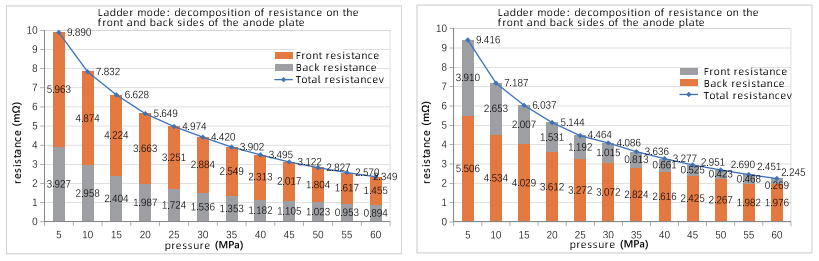
1. Anode sheet resistance contribution decomposition: step test mode |
·The contribution of the resistance on the front and back sides of the anode plate is significantly different;
·Evaluate whether there is inconsistency in the double-sided coating of the anode plate during the production process.
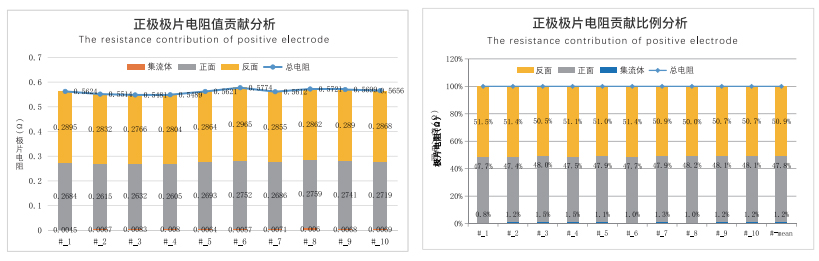
2. Cathode sheet resistance contribution decomposition: single point mode |
·Analyze the resistance contribution of the cathode electrode at different locations (front, back, and current collector);
·Evaluate the impact of the electrode structure and production process on battery performance.
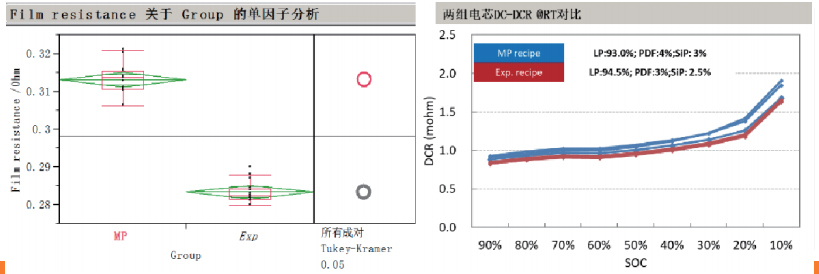
3. Electrode formulation development and evaluation |
·DCR performance under different SOC: experimental formula (Exp) > MP formula; under low SOC, the experimental formula (Exp) shows lower DCR;
·In the development of slurry formula, the film resistance parameter is introduced to analyze the physical properties of the formula in advance, which can predict and judge the performance of the battery cell in advance.
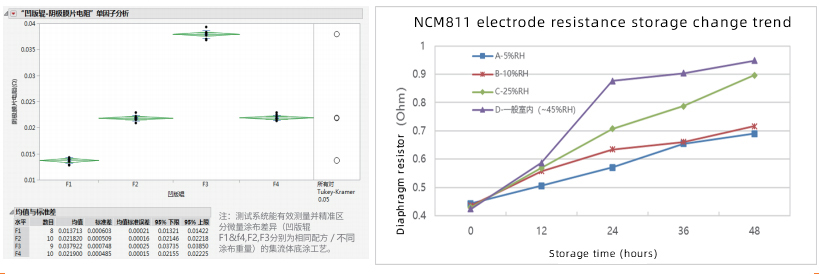
4. Carbon-coated substrate development evaluation and production environment control parameter guidance |
· Accurately measure the change of electrode resistance to provide data support for the development of primer technology;
Production environment control: 10%RH humidity conditions are more favorable for the production of 811 system electrodes.
·This test is only applicable to electrodes with primer technology. Pure primer electrodes are prone to data distortion due to the lack of composite structure.