




 【关注川源科技HiCY】
-

 服务热线 400-700-2017
服务热线 400-700-2017
服务热线 400-700-2017
搜索更多信息

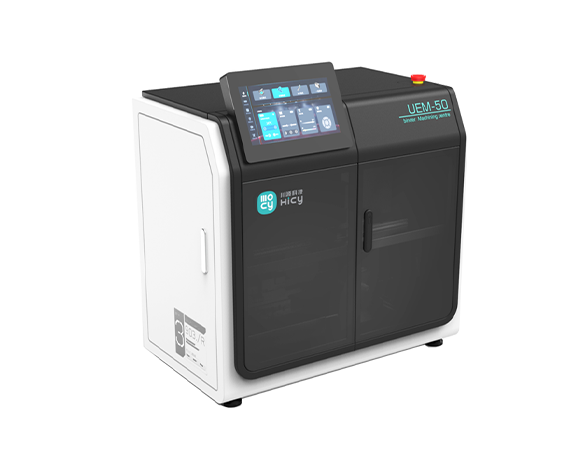

We are committed to solving the problems of expensive equipment, complex operation, low safety and poor test consistency in traditional methods, and realizing fast, accurate and safe analysis of electrode Binder distribution
Application Areas

·Electrode development
Screening of Binder types with better compatibility with active materials
·Process defect diagnosis and quality control
Automatically identify Binder anomalies in local areas of the electrode
Fully automatic detection |
High-precision intelligent servo control |
Professional data processing |
Maximum 1um position accuracy control |
Multiple measurement modes available |
High-precision TGA combined use (customizable) |
Device Model | Regular Edition | High precision version | |
UP-B1 | UP-B1R | ||
Test Principle | Mechanical sampling + TGA thermogravimetry | ||
Test subjects | Pole piece | ||
Mechanism and Motion Control | Control method | High-precision intelligent servo control system | |
Rated load rate | 1-20mm/s | ||
TGA parameters (customers can configure) | Temperature range | RT~1100C | |
Program heating rate | 0.01~50°C/min | ||
Temperature accuracy | ±0.1℃ | ||
Thermogravimetric resolution | 0.02ug | ||
Baseline drift | <10ug (1hour) | ||
Features | ·Anode Binder floating and distribution analysis; ·Single point mode and linear mode are optional; ·One-stop one-step control to complete all measurement processes; ·System configuration MySQL database data traceability security; | ||
Overall dimensions of equipment (L*W*H, mm) | ~300*310*540 | 400*310*540 | |
Total weight of equipment | ~60kg | ~65kg | |
The consistency of binder distribution in the electrode directly affects the performance of the electrode and the battery cell. Currently, there is no effective method for binder floating detection and analysis, and relevant testing methods are urgently needed to be developed.
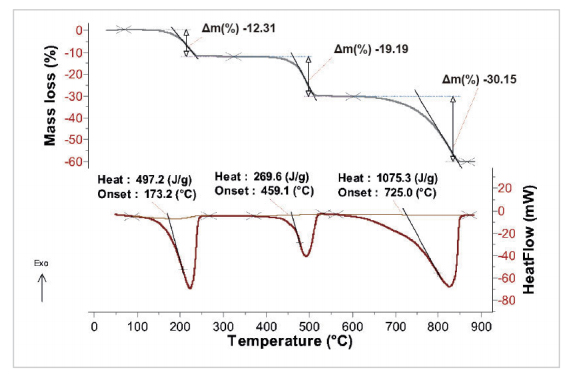
·Thermogravimetric analysis (TGA) is an analytical technique that accurately monitors changes in sample mass over temperature or time. Its core principle is that when a substance is heated, its mass changes due to physical or chemical changes such as volatilization, decomposition, and oxidation.
Example of TGA data curve |
Industry pioneer Industry leaders promote products Chinese and English operation interfaces | High precision Sampling process parameters are collected and recorded throughout the process Up to 1μm position accuracy control | Fully automatic detection Realize fully automatic sample collection and detection Use with high-precision TGA (customizable) | Professional data processing Single point mode and linear mode are optional Measurement data is displayed online in real time |
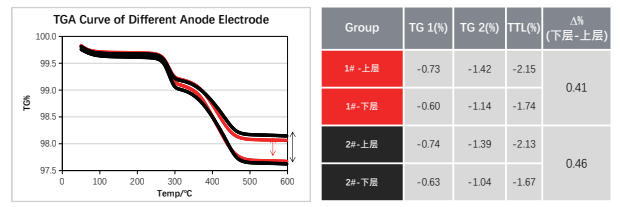
1. TG data of pole pieces with different Binder designs |
·With the increase of energy density requirements and the continuous increase of coating tape speed, the binder in the production of anode pole pieces is more and more prone to uneven floating distribution;
·From the sample data, the closer the TG curves of the upper and lower layers are, the smaller the ∆ is, indicating that the floating and stratification of the binder in the membrane are not obvious. The binder is also more evenly distributed in the Z direction of the pole piece.
2.TG analysis of powder between different layers of pole piece |
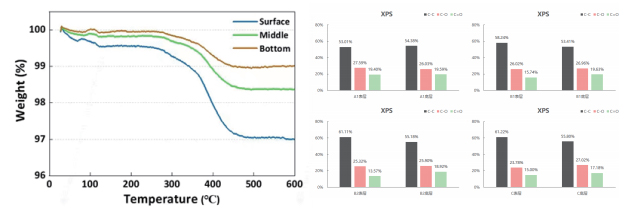
·The data show that the binder floats up seriously, and the mass fractions of the top, middle and bottom layers of binder are 2.976%, 1.651% and 1.032% respectively.
·After XPS analysis of the top and bottom layers of powder, it is found that the binder content of the top and bottom layers of the electrode after surface treatment is basically at the same level, proving that the surface treatment is effective.