


 【关注川源科技HiCY】
-

 服务热线 400-700-2017
服务热线 400-700-2017
服务热线 400-700-2017
搜索更多信息



Committed to solving the problems of coating cracking, increased internal resistance and shortened battery life caused by insufficient flexibility of the pole piece, and achieving accurate evaluation of the bending resistance of the pole piece
Application Areas

·Flexibility test of substrate and composite substrate
Quantify the mechanical response of substrates at different bending angles
·Pole piece turning angle and bending degree
·Post-coating flexibility of carbon-coated substrate
Evaluate the bonding strength and overall durability of the coating to the substrate
New multi-probe technology |
Simultaneous multi-channel measurement at one time |
One-stop testing |
Exclusive PCT patent technology |
No contact resistance |
One model fixture compatible |
| Device Model | Single channel version | |
Flex 10 | ||
Number of channels | 1 | |
Test Principle | Bending method | |
Measurement functions | Pole flexibility, Pole flexibility | |
Test subjects | Applicable to paper and other composite materials with thickness ranging from (0.01~5.0)mm | |
Force value Measurement | Range | 0-1000mN |
Accuracy | ±0.1% | |
Resolution | 0.01mN | |
Angle Measurement | Range | 1~92° infinitely adjustable |
Accuracy | ±0.1° | |
Resolution | 0.1° | |
Angle measurement | A single test can measure 3 different angles at the same time, 1-90° can be set arbitrarily | |
Temperature and humidity | Range | -20-80°C/5-95%RH |
Accuracy | ±2°C,/±3%RH | |
Mechanism and Motion Control | Motion Motor | Servo Motor |
Angular velocity control | 0.5-50°/sec adjustable, three test angles and durations independently adjustable | |
Software Features | The system is a one-stop one-step control system that completes all measurement processes; the system has visual inspection and recording functions; the equipment can achieve self-calibration and comes with a calibration tool as standard | |
Equipment size (L*W*H, mm) | ~300*310*240 | |
Equipment weight | 25kg | |
The flexibility of the pole piece describes the pole piece's ability to resist bending deformation and structural stability under different temperature, humidity and mechanical stress conditions. As the core component of the battery, the flexibility of the pole piece directly affects the battery's processing performance (such as winding, lamination), interface contact stability and long-term cycle life.
Lithium-ion battery pole piece (three-layer structure composite material) → =electrode coating + current collector foil | Pole flexibility → = Bendability (ability to bend once without breaking) + | The electrode is not flexible enough → ↓ · Coating cracks · Foil breaks ↓ | Impact on battery cells ↓ ·Battery cell capacity ·Battery cell cycle life ·Battery cell safety |
Positive/negative current collector
Positive/negative base Positive/negative electrode | Resilience (ability to bend repeatedly) | ·Increase in battery internal resistance ·Battery capacity attenuation |
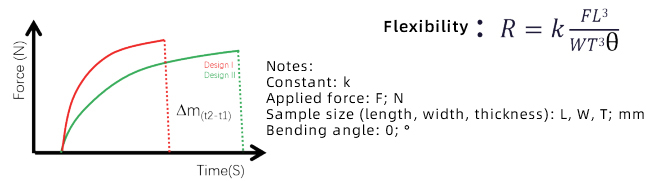
·By measuring the force or torque required to bend the clamped sample to a given angle, the force acts on a constant bending length, and the flexibility is measured by the high-precision force sensor in the flexibility tester.
High-precision measurement ±0.1% accuracy force sensor Resolution up to 0.01mN | Multi-environment simulation capabilities Supports precise control of temperature (20~80°C) and humidity (5~95% RH) Simulates actual working conditions of the electrode | Flexible test mode A single test can measure 3 different angles simultaneously (1~90° infinitely adjustable) | Self-calibration function Built-in calibration tool to maintain measurement consistency over long-term use |
1. Evaluation of the flexibility of different pole pieces |
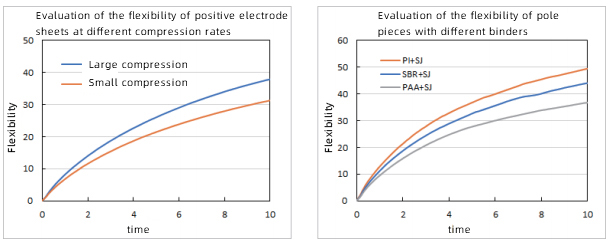
Through the pole piece flexibility measuring instrument, the test shows that as the pole piece compression increases, its flexibility value increases (the larger the flexibility value, the harder the pole piece). In addition, for pole pieces with different binders, the pole piece using PAA cross-linking agent has the best flexibility.