








 【关注川源科技HiCY】
-

 服务热线 400-700-2017
服务热线 400-700-2017
服务热线 400-700-2017
搜索更多信息

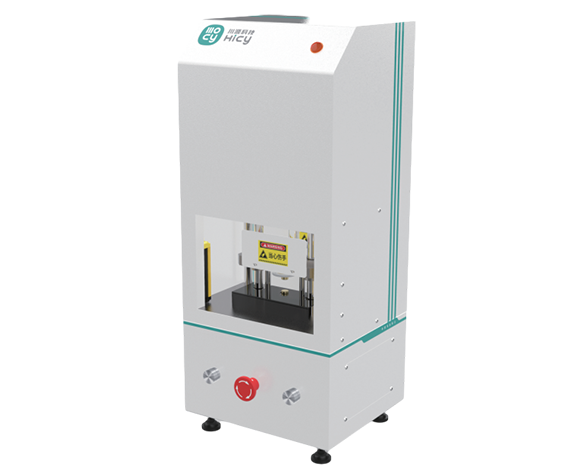

Committed to solving the resistance measurement distortion problem caused by the composite current collector insulation layer structure in traditional methods, and realizing accurate detection of the overall resistance and double-sided consistency of the composite electrode
Application Areas

· Composite current collector development
· Composite current collector process stability monitoring
· Composite electrode production stability monitoring
· Composite current collector/electrode short circuit evaluation
New multi-probe measurement |
One-click non-destructive testing |
New probe design |
One-stop data collection and analysis |
Exclusive patented technology |
Multiple measurement modes available |
Model | Comp4R | Comp6R | |
Pressure method | Cylinder (needs air source, pressure range: 0~35MPa, optional servo motor, pressure range 0~60MPa) | ||
Voltage regulation method | automatic | automatic | |
Applicable samples | Composite current collector, primer composite current collector Composite current collector pole piece | ||
Test method | Offline | ||
Test Parameters | Resistance, resistivity, thickness, compacted density (input weight), pressure/pressure, temperature and humidity | Resistance, resistivity, A/B surface resistance, thickness, compaction density (input weight), pressure/pressure, temperature and humidity | |
Specifications | 1. Instrument size: 420*385*480mm 2. Instrument weight: 20kg 3. Instrument power: 400W | 1. Instrument size: 420*385*480mm 2. Instrument weight: 20kg 3. Instrument power: 400W | |
Test functionality | Single point mode | ★ | ★ |
Continuous Mode | ★ | ★ | |
Transformer mode | ★ | ★ | |
Fully automatic measurement | ★ | ★ | |
Thickness | ★ | ★ | |
Weight | / | / | |
A/B resistor | 、 | ★ | |
Other | Measuring terminal diameter: main probe 14mm, auxiliary probe 30mm | ||
Advantages comparison
Product | Hicy Product | Competitors |
Principle | New multi-probe | |
Technological innovation | Exclusive patented technology | none |
Measurement functions | Composite current collector, composite pole piece A/B surface resistance decomposition, double-sided coating consistency, etc. | none |
Applicable samples | All pole pieces, bottom-coated pole pieces and other traditional types of pole pieces | none |
Measurement characteristics and data validity | · One-touch non-destructive testing is realized for the first time; · High reliability of one-time measurement data and small system test error; · Realize the detection of the front and back resistance of the current collector/electrode to improve the consistency of the quality of the electrode and the quality of the battery cell. | none |
Test efficiency | One-shot completion | / |
Equipment cost | Basically the same as the previous generation of products | / |
Comprehensive recommendation index | ★★★★★ | / |
Composite current collector is a multilayer structure material composed of alternating conductive layers (such as aluminum foil, copper foil) and insulating layers (such as PET, PI), which has both conductivity and mechanical support functions. In the future, composite current collector is expected to become the mainstream current collector material and promote the development of the lithium battery industry
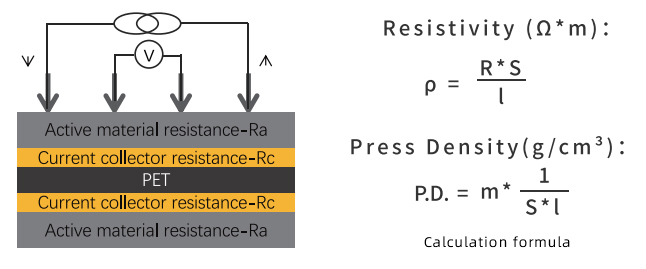
·New multi-probe measurement principle
·Due to the insulating layer in the middle of the composite current collector, the traditional two-probe resistor cannot accurately measure its resistance value.
·The instrument adopts a new probe design and is equipped with a fully closed-loop intelligent servo control system to realize the overall resistance of the composite electrode and its double-sided resistance consistency and other characteristic detection.
Note: Ra is the overall resistance of the active coating, Rc is the current collector resistance, m is the pole piece weight, S is the sample area, l is the sample thickness |
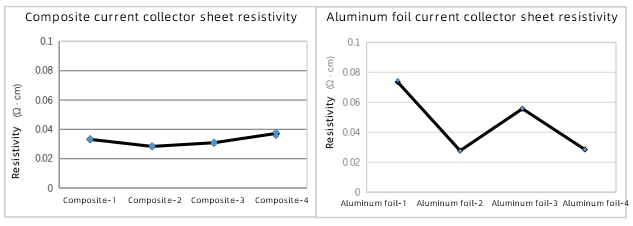
1. Composite current collector vs. aluminum foil current collector ·The resistance of the composite current collector is at the same level as that of the aluminum foil current collector; ·The composite current collector can provide the same level of electrical performance as the traditional aluminum foil current collector.
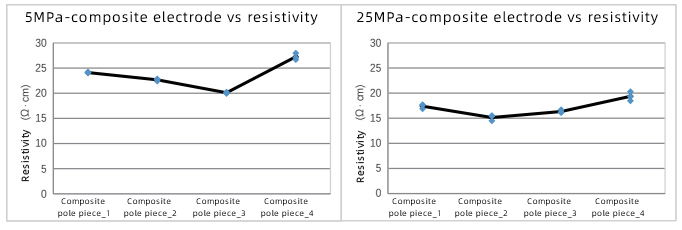
| 2. Application of resistance difference analysis of composite electrode under different pressures ·As the applied pressure increases, the electrode resistance decreases accordingly; ·Evaluate the effect of pressure on the conductivity of the composite electrode, provide a reasonable pressure range, and help optimize the production process.
|