





 【关注川源科技HiCY】
-

 服务热线 400-700-2017
服务热线 400-700-2017
服务热线 400-700-2017
搜索更多信息

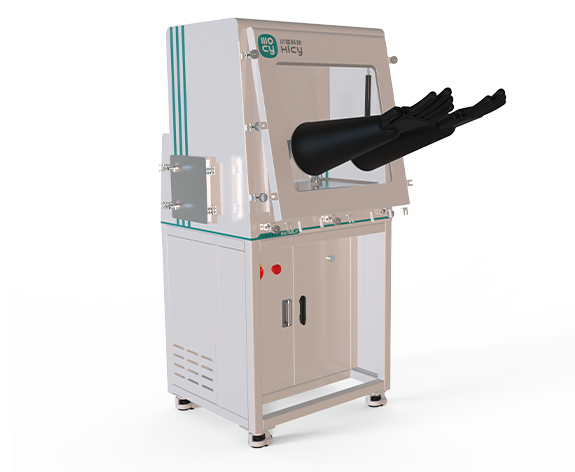


We are committed to solving the problem of complex process and low efficiency caused by the traditional method of preparing full battery/symmetrical battery, and realizing one-stop rapid ion conductivity detection of diaphragm and film materials
Application Areas

·Diaphragm material development evaluation
·Pole tortuosity test
·Diaphragm production stability test
Multi-channel simultaneous measurement |
One-step rapid in-situ impedance detection |
PCT Patent Technology |
One-stop fully automatic rapid measurement |
High precision temperature control |
Extremely simplified probe design |
Device Model | All-in-one normal temperature version | Integrated temperature control version |
SIC A6 | SIC A6L | |
Test Principle | Five-point linear fitting method | |
Test Beat | 20 seconds a set of data | 60 seconds a set of data |
Test functionality | Ion conductivity of diaphragm, ion conductivity of binder film, ion conductivity of adhesive film | |
Test subjects | Isolation film, binder film | |
Test pressure | Constant pressure | (<5kPa) 1~7MPa |
Test temperature | Normal temperature | -20~80°C |
Conductivity | 0.01μS/cm-10S/cm | |
Probe fixture | P-20-SR mold diameter: 20mm | |
Measurable parameters | Ionic conductivity, McMullin number | Ionic conductivity, McMullin number, thickness, pressure, temperature, humidity |
Features | ·No inert atmosphere required; ·The software interface displays the test points and performs linear fitting on the test points, automatically outputting ion conductivity and McMullin number; ·Ion conductivity under constant pressure; ·Automatic waste liquid cleaning and waste liquid collection device; ·Multiple account login permission settings; ·Fully automatic measurement software; | ·No inert atmosphere required, with built-in humidity control function (<30%RH); ·The software interface displays the test points, performs linear fitting on the test points, and automatically outputs ion conductivity and McMullin number; ·Ion conductivity under different pressure and temperature conditions; ·Automatic waste liquid cleaning and waste liquid collection device; ·Multiple account login permission settings; ·Fully automatic measurement software; |
Equipment size (L*W*H, mm) | 450*600*600 | 700*700*1700 |
The ion conductivity of the diaphragm is an important factor affecting battery performance and an important parameter to characterize the performance of the diaphragm. Therefore, there is a huge demand for ion conductivity testing of the diaphragm. There will be a large number of testing requirements in formula optimization, process changes, quality monitoring and customer complaint resolution.
Current testing of membrane ion conductivity |
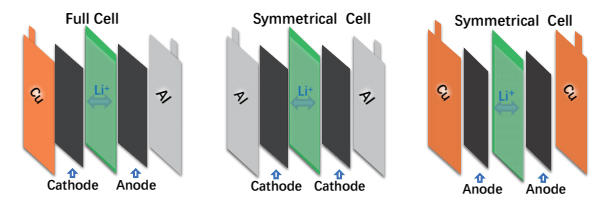
· Make full batteries, symmetrical batteries or small-sized simple batteries
· The process is lengthy and complicated, with many influencing factors
· Urgent need for quick and simple evaluation methods and equipment
·AC impedance method: The impedance of the diaphragm is measured based on the AC impedance method, and the slope is calculated by the five-point method to obtain the ionic conductivity of the diaphragm.
·Eliminating contact resistance: By separating the current application end (two outer electrodes) and the voltage detection end (two inner electrodes), the interference of the electrode/diaphragm interface contact resistance on the measurement is avoided;
·Frequency selection: Measure in the high frequency region of 10 kHz~1 MHz, at which time the ion migration response is dominant and the contribution of electronic conduction can be ignored;
·Equivalent circuit model: Corresponding to the pure resistance characteristic (the intersection of the high frequency region and the real axis in the Nyquist diagram).
 |
R -- impedance σ -- Electrical conductivity ρ -- Resistivity S -- Area of separator film L -- Thickness of separator n -- Number of layers |
Measurement Mode

The test system implements the following functions (similar to battery charging and discharging, CC+CV mode, Step Charge mode); different loading pressure rates to the target pressure, the target pressure is maintained for a certain time, the corresponding information is recorded, and the test is completed;
Single point mode
| Continuous Linear Mode
|
Product | Hicy Product | Competitors | Competitors |
Principle | One-step rapid in-situ impedance detection method | Traditional symmetrical battery assembly + impedance test method | Traditional symmetrical battery assembly + impedance test method |
Number of channels | Single channel (can be completed in one go) | Four channels can be synchronized to complete | Four channels can be synchronized to complete |
Key Takeaways | ·No need to assemble batteries, no influence of manual assembly differences, high efficiency: ·Fully automatic testing, simple operation by personnel; ·High-precision temperature control, time-different temperature detection ·Fully automatic data output, no need for manual data processing and fitting analysis: ·No auxiliary supporting and consumables sales, low comprehensive use cost: | · Manual assembly of batteries, huge impact of assembly differences, poor consistency: · Requires matching detection of pole pieces, the impact of pole pieces is immeasurable, and the impact of batch cycle measurement is huge: · Manual assembly, low efficiency, high labor cost: · No temperature control, large uncertainty in different temperature detection; · Data output in steps, manual data processing and fitting analysis, low efficiency: · Requires matching glove box, inert gas, and high long-term use cost of pole pieces: | |
Test efficiency | One sample per minute | 3 hours assembly rest before testing | 3 hours assembly rest before testing |
Experimental environment | Ordinary indoor | Glove box + additional inert gas protection | Ordinary room + additional inert gas protection |
1. Test of ionic conductivity of adhesive film (binder) |
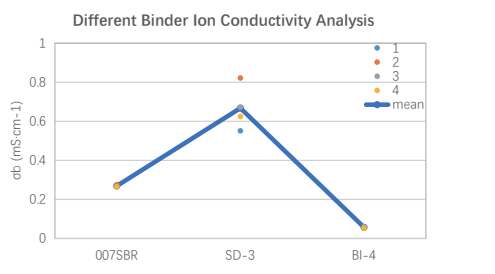
· Ionic conductivity: BI-4<007SBR<SD-3;
· Study the effect of adhesives on battery ionic conductivity; provide a basis for selecting suitable adhesive films in battery electrode production.
 |
1. EIS test:
Frequency range 1Hz~500KHz,
Amplitude: 5mV,
Test temperature: RT;
2. Binder film thickness: 20~200um;
3. Electrolyte: FE33;
| σ(mS/cm) | Conductivity (mS/cm) |
| 007SBR | 0.26888 |
| SD-3 | 0.66761 |
| BI-4 | 0.05693 |
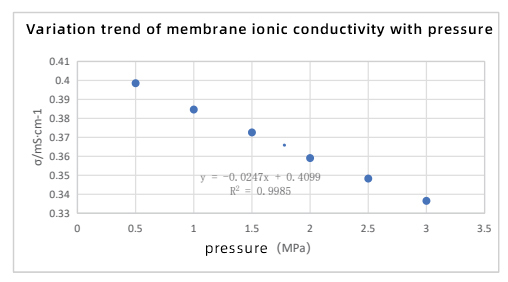
2. Test of ionic conductivity of controlled pressure plate diaphragm |
· The ionic conductivity of the diaphragm was tested at different pressures using a step mode. The ionic conductivity of the diaphragm decreased with increasing pressure.
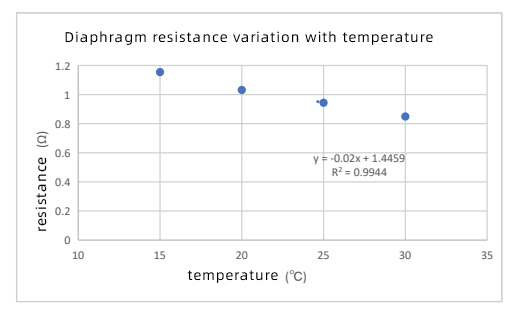
3. Temperature Control Plate Diaphragm Ionic Conductivity Test |
· The resistance of the diaphragm is tested at different temperatures using a step mode. The diaphragm resistance decreases with increasing temperature, while the ionic conductivity increases with increasing temperature.
4. One-stop testing method application case |
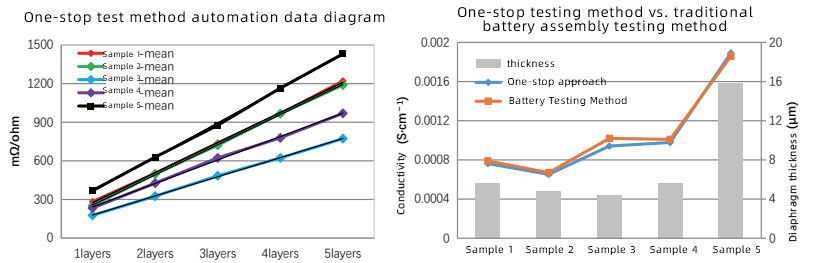
· The new method for evaluating the ionic conductivity of the diaphragm samples is consistent with the traditional battery assembly test method, and the results are also the same, indicating that the test method can perfectly replace the existing inefficient test methods.