



 【关注川源科技HiCY】
-

 服务热线 400-700-2017
服务热线 400-700-2017
服务热线 400-700-2017
搜索更多信息

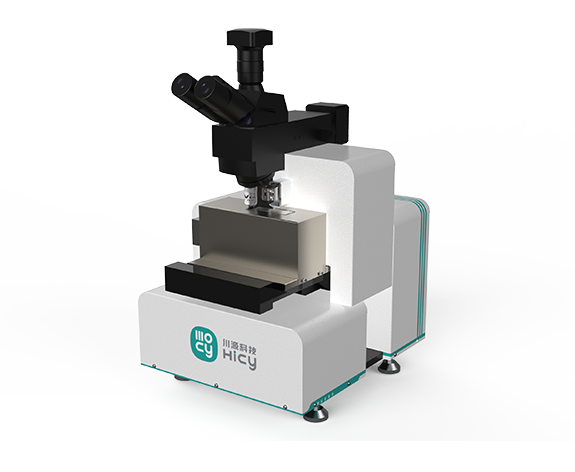

We are committed to solving the problems of insufficient precision, high cost and import dependence of traditional equipment, and realizing one-stop high-precision detection of single particle mechanical properties (such as compression resistance and rebound) and resistance characteristics.
Application Areas

·Single particle mechanical property analysis and testing of positive/negative electrode material research and development, guiding the setting of roller pressure, speed and other parameters to improve the uniformity of the electrode sheet
·Single particle resistance property analysis and testing to select high conductivity particles and guide electrode formula design through conductivity data
New multi-probe technology |
High-precision displacement control and detection |
Comply with national recommended standards |
High-resolution optical imaging |
Multiple measurement modes available |
XYZ automatic displacement stage |
Device Model | Particle H1 | Particle H2 | |
Product Features | Crushing force | Crushing force + resistance | |
Test subjects | Precursor materials, solid electrolyte materials, anode, cathode and other particles | ||
Displacement | Range | 0-80μm | |
Accuracy/resolution | Minimum 1nm | ||
Pressure | Range | 0.01~2000mN | |
Accuracy/resolution | ±0.5% | ||
Temperature and humidity | Range | 0-80°C/5-95%RH | |
Accuracy | ±2℃、±3%RH | ||
Particle image observation | ● | ● | |
Automatic down pressure control | ● | ● | |
Automatic displacement platform | ● | ● | |
Software Features | ·Fully automatic communication connection; ·Measurement times statistics, single point, linear and other test modes are optional; ·Measurement auxiliary judgment; ·Standard test data report output; | ·One-button automatic zeroing and calibration; ·Real-time data acquisition, recording and preview; ·Over-range display and measurement abnormality inspection; | |
Equipment size (L*W*H, mm) | 300*185*150 | 300*605*610 | |
Equipment quality | 38kg | 43kg | |
·Single-particle mechanics and electron transport performance are the core elements to improve battery performance. The single-particle compressive strength directly affects the powder compaction density and the optimization of the electrode rolling process. The single-particle electronic conductivity ensures efficient electron transmission of the electrode by reducing internal resistance, enhancing charge and discharge rate performance, and inhibiting the degradation of contact resistance during the cycle.
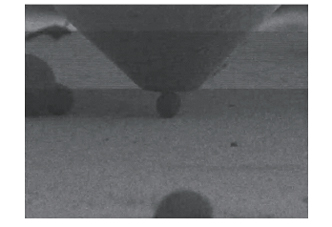
Test method: The microsphere particles are dispersed with a solvent and placed on a stage, and a compression test is performed using a test system, and then observed under an optical microscope;
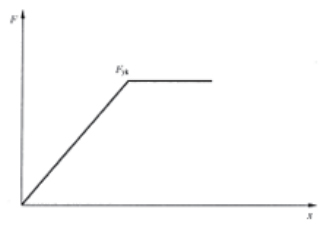
Relationship curve between test force and compression displacement during crushing process |
Microscope 3D scanning: Particle extrusion | Force displacement control system Displacement measurement system Optical microscope Pressure test head Sample support system |  |
High precision High-precision displacement control and detection High-resolution optical imaging Ultra-high-precision mechanical detection XYZ automatic displacement platform | Multiple function modes Single point and linear modes are available Displacement control mode Pressure-release mode Fatigue test mode | Professional data analysis management Fully intelligent precision mechanical control One-stop collection and recording of key parameters Measurement correlation prediction MySQL database management mode | Domestic substitution is the first choice The first choice for domestic substitution High cost performance |
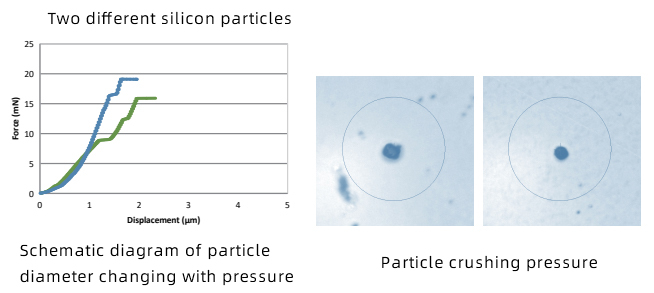
1. Silicon Carbon-Single Particle Crushing Test The appearance of steps or mutations during the compression process indicates that the particles are partially broken/crushed; compressive strength: blue particles > green particles. The crushing positions and crushing force values of different particles do not show consistent regularity.
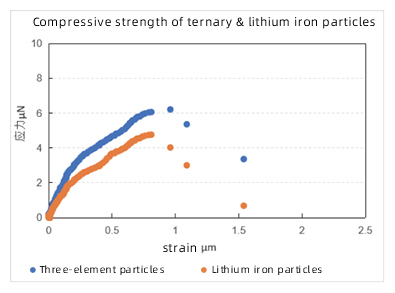
| 2. Compressive strength of ternary & iron lithium particles Ternary and iron-lithium particles were prepared in the same way, and the stress and strain of the particles were evaluated by extrusion test of single particles: the extrusion force of ternary particles was greater than that of iron-lithium particles.
|