


 【关注川源科技HiCY】
-

 服务热线 400-700-2017
服务热线 400-700-2017
服务热线 400-700-2017
搜索更多信息

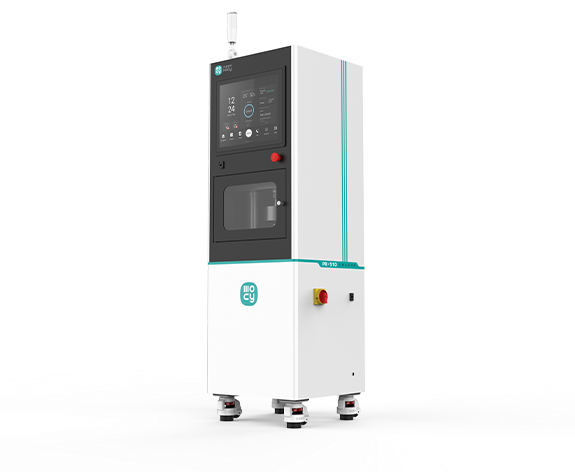

Committed to solving the pain points of contact resistance, poor resistance range compatibility, low test efficiency, poor consistency, etc. in traditional powder resistance testing, and realizing simultaneous multi-channel measurement of powder resistance
Application Areas

·Battery material research and development
·Battery manufacturing and quality control
Quality consistency evaluation of powder materials
Screening of abnormal batches of raw materials/process parameters
·Scientific research
Study powder microstructure, conductivity mechanism, particle contact behavior
New multi-probe technology |
Simultaneous multi-channel measurement at one time |
One-stop testing |
Exclusive PCT patent technology |
No contact resistance |
One model fixture compatible |
Device Model | Single channel version | Multi-channel version | |||
PR310 | PR | 51 0 | PowderX1 | Powder X3 | |
Test Principle | Two-probe/four-probe | Multi-probe | |||
Test Beat | A single test of a set of data | Multiple sets of data in a single test | |||
Test subjects | Positive electrode powder; Negative electrode powder; Conductive agent powder such as graphene and carbon nanotubes | ||||
Test pressure | 1t | 5t | 1t | 5t | |
Resistance range | 1μ Q~200MPa | 1μQ~1200Mpa | 1μQ~1200Mpa | ||
Thickness range | 0-10mm | ||||
Probe fixture | PR-C13 (single probe fixture) PR-M133 (multi-probe fixture) | ||||
Measurable parameters | Resistance, resistivity, thickness, compaction density, ambient temperature and humidity, pressure, | ||||
Features | ·Single point, linear, step, pulse and other test modes are available; ·Measurement times statistics; ·Standard test data report output; ·Over-range display; | ·Fully automatic communication connection, one-button automatic zeroing and calibration; ·Production measurement auxiliary judgment; ·Real-time data collection, recording and preview; ·Measurement abnormality inspection; | |||
Equipment size (L*W*H, mm) | 520*385*580 | 600*485*1700 | 520*385*580 | 600*485*1700 | |
Equipment weight (kg) | 100 | 250 | 100 | 250 | |
Power (W) | 400 | 2100 | 400 | 2100 | |
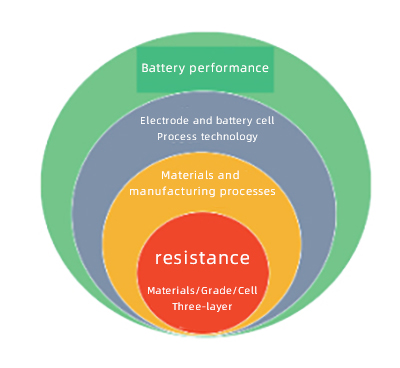
·Material resistance directly affects the power performance of the entire battery. Analyzing the powder resistance characteristics is of great significance in quickly predicting battery performance;
·The resistivity of powder conductive materials is directly related to the resistance characteristics and particle size of the material itself, and is also directly related to the tightness of the powder stacking;
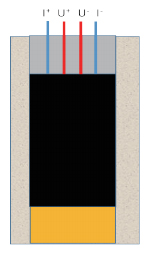
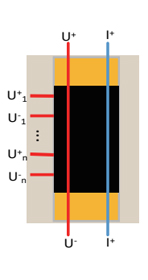
·New multi-probe technology: multiple probes are integrated in the sample loading height direction to detect the resistance of multiple powder segments at the same time;
·Measurement method: each probe applies current and measures voltage independently, and the resistance value is calculated by combining the data of multiple measurement points;
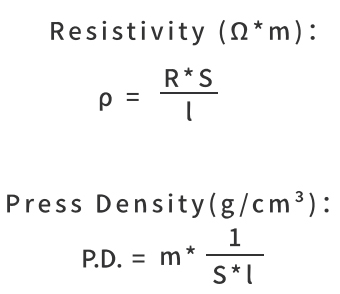
·Data processing and calculation: Combine current, voltage, probe spacing and sample thickness to calculate the resistivity of the sample and analyze the conductivity characteristics;
·Measurement result output: The system displays the resistance value, resistivity and other results in real time.
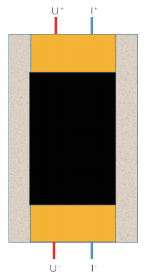
Calculation formula:
|
Two probes |
Four probes |
Multi-probe |
Measurement Mode

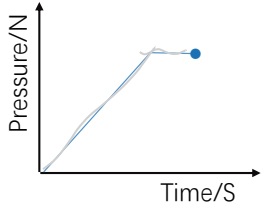
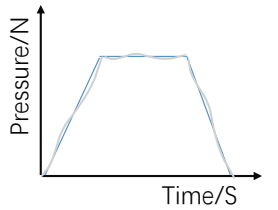
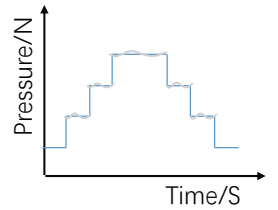
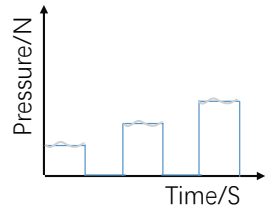
·The test system realizes the following functions (similar to battery charging and discharging, CC+CV mode, Step Charge mode);
·Load pressure at different rates to the target pressure, keep the target pressure for a certain time, record the corresponding information, and complete the test;
Single point mode
| Continuous Linear Mode
| STEP Linear Mode
| Pulse Linear Mode
|
project | Traditional external leakage four-probe | Two probes | Embedded four-probe | New multi-probe |
Comprehensive efficiency | ★ | ★★★ | ★★★ | ★★★★★ |
Measurement Mode | Ex situ multi-station | In-situ one-stop | In-situ one-stop | In-situ one-stop |
Consistency of results | Measure one data point at a time | Measure one data point at a time | Measure one data point at a time | Measure multiple (2~n) data points at a time |
Data Validity | ·Complicated testing process ·Unknown expansion, inaccurate thickness test, unreliable results | · There is a large deviation in the measurement of multiple samples · The measurement results are contributed by the contact resistance, and only the larger resistance value can be measured, otherwise the error will be large; | · There is a large deviation in the measurement of multiple samples · The four-probe measurement method is not suitable for testing samples with large thickness/high resistance; | ·Multiple parallel results from one sample loading, good consistency; ·No contact resistance; |
Test efficiency | Parallel samples require multiple operations | Parallel samples require multiple operations | Parallel samples require multiple operations | One-shot completion |
Applicable samples | Low resistance | High resistance | Low resistance | all |
Cost | 1.5 | 1 | 1 | 1/n |
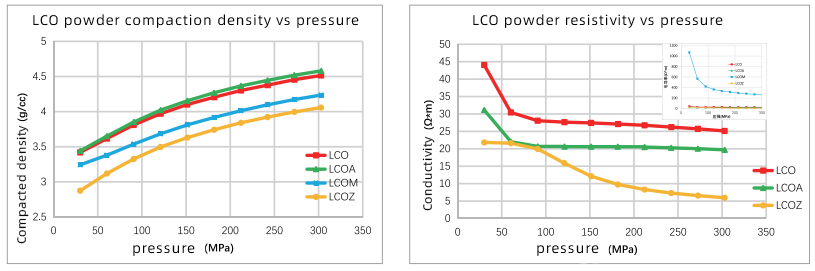
1. Analysis of different coated modified LCO |
·Resistivity: LCOZ<LCOA<LCO<LCOM; compaction density: LCOZ<LCOM<LCO<LCOA
·LCOA improves the conductivity of LCO material without losing compaction density.
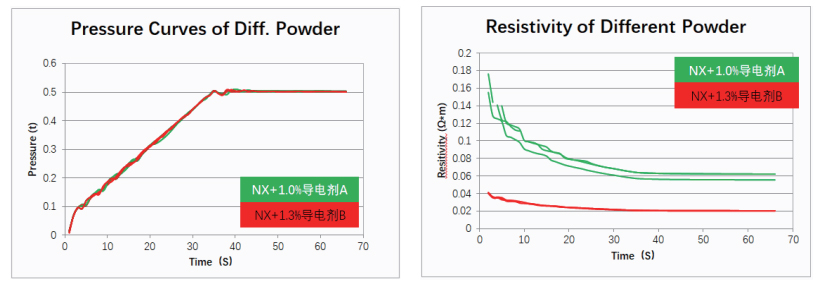
2. Analysis of positive electrode resistance of sodium battery |
· Overall conductivity: NX+1.3% conductive agent B>NX+1% conductive agent A;
· Evaluate the difference in conductivity performance of sodium ion battery polyanion positive electrode materials mixed with different conductive additives, and clarify the optimization effect of conductive agent type and addition ratio on material conductivity.
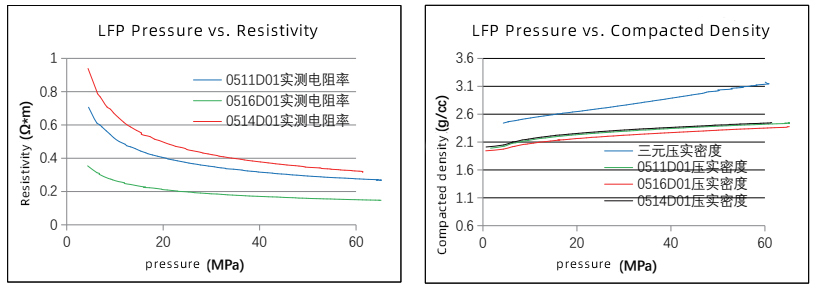
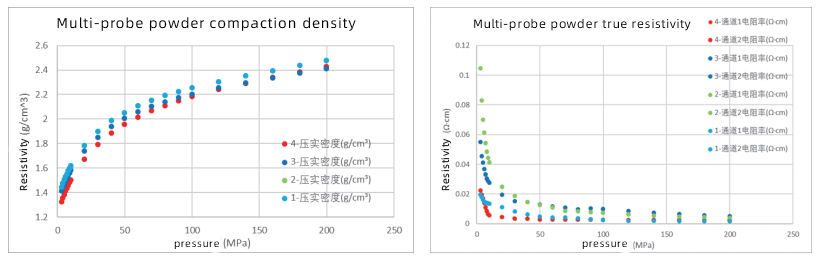
3. Relationship between powder compaction density, resistivity and pressure |
·The compaction density of the powder increases as the pressure increases as the terminal is pressed down continuously;
·The resistance/resistivity of the powder changes significantly in the early stage as the pressure increases, and the change trend slows down when the pressure exceeds a certain limit.
4. Test analysis of different LFP materials |
·Resistivity: high energy type (0514) > capacity type (0511) > rate type (0516);
·Evaluate the correlation between powder material type (capacity type, rate type, high energy type) and resistivity and compaction density to provide data support for optimizing battery positive electrode material formula and process parameters.