





 【关注川源科技HiCY】
-

 服务热线 400-700-2017
服务热线 400-700-2017
服务热线 400-700-2017
搜索更多信息

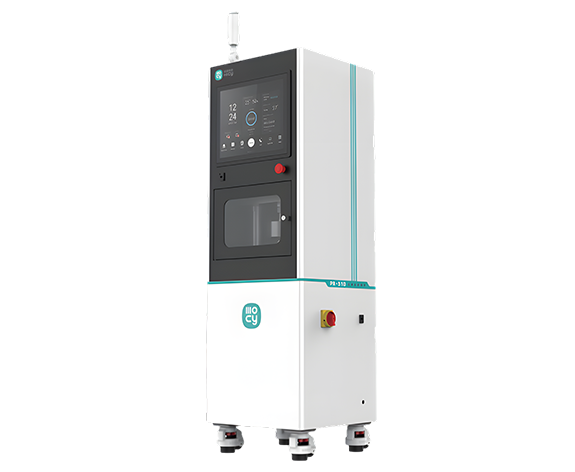

We are committed to solving the problems of insufficient frequency range, non-situ/low-voltage test distortion, lack of temperature control, etc. in existing measurement technologies, and realizing high-frequency and accurate detection of electronic/ionic resistance of solid electrolytes
Application Areas

·In-situ preparation of powder materials such as solid electrolytes
·Testing of ionic resistance/electronic resistance of solid electrolytes
·Testing and evaluation of electrochemical properties of solid electrolytes
New multi-probe technology |
Multiple measurement modes available |
One-stop testing |
300MPa ultra-high pressure output |
One fixture compatible |
One-stop/self-connected electrochemical workstation |
| Device Model | Solid XJ | Solid X3 |
Test Beat | Multiple sets of data in a single test | |
Test Principle | Multi-probe | |
Test subjects | Solid electrolyte powders (oxides, sulfides, halides, etc.) | |
Test pressure | 5T | |
Pressure | 350MPa (two probes) | |
Thickness range | 0-8mm | |
Resistance (impedance) range | X(external) 10Hz-130MHz or other | |
Humidity | Fixture humidity control<5%RH | Glove box humidity control<5%RH |
Measurable parameters | Ionic resistance, ionic resistivity, ionic conductivity, thickness, compaction density, ambient temperature and humidity, pressure, pressure | |
Probe fixture | PR-C13 diameter: 13mm (other specifications can be customized) | PR-M133 diameter: 13mm (other specifications can be customized) |
Features | ·Single point, pulse, step and mixed modes are available; ·Solid electrolyte electronic resistance, ionic resistance and electrical performance characteristics detection; ·One fixture is compatible with all high and low resistance sample tests; ·One-stop or self-connected electrochemical workstation to achieve more functional tests; ·MES connection communication (customized); ·Software fully automatic measurement; | |
Equipment size (L*W*H, mm) | 300*385*300 | 600*485*1700 |
At present, liquid lithium batteries have almost reached their limit, and solid-state lithium batteries are the only way for the development of lithium batteries. The most important performance indicators of solid-state electrolytes are ionic conductivity, electronic conductivity and interface stability, among which the most important is interface control.
Technical challenges of solid-state electrolytes · Balance of ionic and electronic conductivity · Poor solid-solid interface contact between electrode and solid electrolyte resulting in high impedance · Process complexity | Limitations of current conductivity measurements of solid electrolytes ·Frequency limitation: conventional electrochemical workstation frequency (≤10MHz). ·Non-situ test defects: impedance measurement after non-situ or low-voltage tableting ·Lack of temperature control system ·Equipment cost and function limitations |
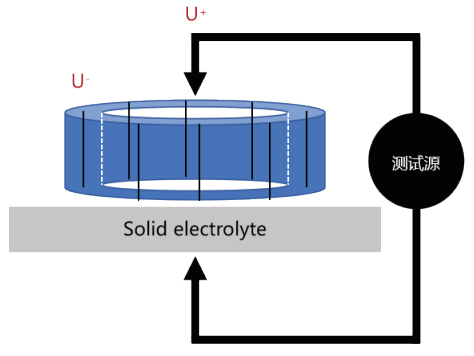
·New multi-probe technology: multiple probes are integrated in the sample loading height direction to detect the resistance of multiple sections of powder at the same time;
·Measurement method: each probe applies current and measures voltage independently, and the resistance value is calculated by combining the data of multiple measurement points;
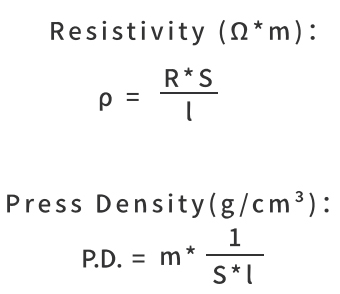
·Data processing and calculation: Combine current, voltage, probe spacing and sample thickness to calculate the resistivity of the sample and analyze the conductivity characteristics;
·Measurement result output: The system displays the resistance value, resistivity and other results in real time.
Calculation formula:
|
Schematic |
Industry's first Achieve maximum 300MPa ultra-high measurement pressure output Leading battery and material companies promote products | Multi-channel One fixture is compatible with all high and low resistance sample tests One-stop or self-connected electrochemical workstation to achieve more functional tests | One-stop Fully intelligent closed-loop servo control, one-stop collection and recording of key parameters such as pressure, resistance, temperature, humidity, thickness, etc. | Professional data Single point, pulse, step and mixed modes are available MES connection communication (customized) |
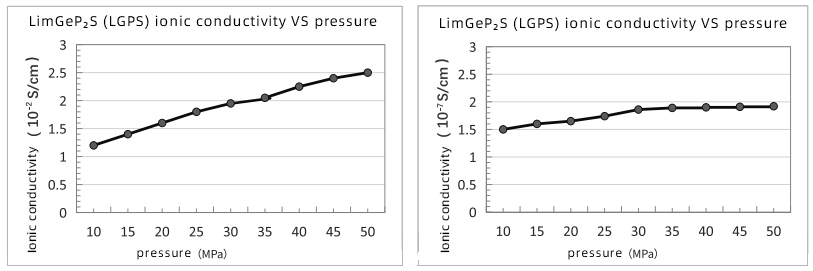
1. Ionic conductivity and electronic conductivity test |
· Appropriately increasing the pressure can help improve the electrical conductivity of LGPS solid electrolytes, especially the ionic conductivity;
·Evaluate the effect of different pressures on the electrical conductivity of solid electrolytes.
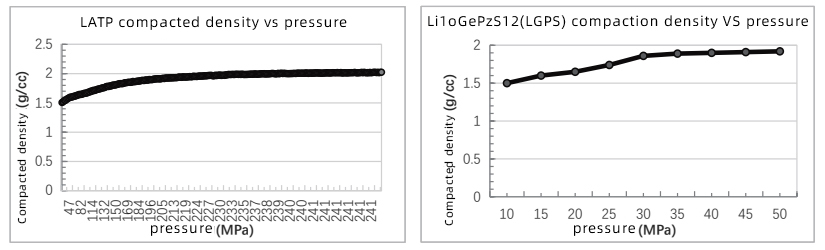
2. Evaluation of solid electrolyte compaction density |
·The compaction density test of Li10GeP2S12 (LGPS) solid electrolyte under variable pressure can be used to evaluate the development of solid electrolytes and related process optimization such as compaction density.
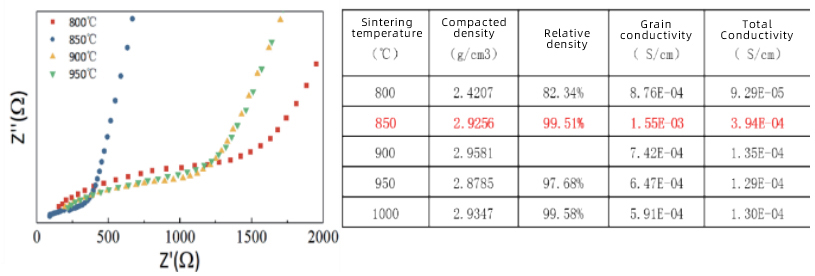
3. Electrochemical performance evaluation: Evaluation of LATP oxide solid electrolyte |
·The electrical performance of LATP oxide solid electrolytes synthesized at different reaction temperatures was tested and analyzed;
·The experiment found that the LATP material synthesized at 850℃ has the best performance.
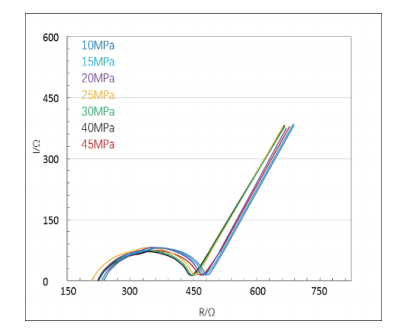
4. Electrochemical performance evaluation: Electrochemical impedance spectroscopy scanning under different pressures |
·Based on the assembly of Li metal-solid electrolyte (Li10GeP2S12(LGPS))-stainless steel battery in the sealed fixture of Solid X test system, electrochemical impedance spectroscopy scanning can be performed to obtain electrochemical impedance spectroscopy data of the battery under different pressure modes;