







 【关注川源科技HiCY】
-

 服务热线 400-700-2017
服务热线 400-700-2017
服务热线 400-700-2017
搜索更多信息

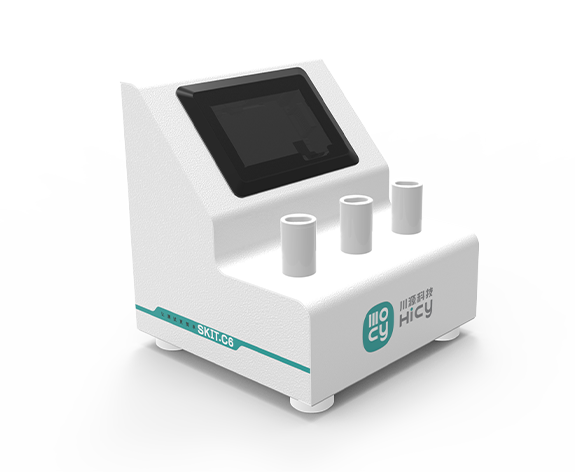

We are committed to solving the problems of insufficient frequency range, non-situ/low-voltage test distortion, lack of temperature control, etc. in existing measurement technologies, and realizing high-frequency and accurate detection of electronic/ionic resistance of solid electrolytes
Application Areas

·Material development evaluation
·Process stability monitoring
·Slurry stability analysis
·Process development
New multi-probe technology |
Three-channel split electrode cup |
One-stop testing |
Multi-area parallel sample synchronous measurement |
Multiple measurement modes available |
Professional data processing |
Device Model | Basic Edition | Online version | |
Skit C6 | Skit C9 | ||
Number of channels | 3 | / | |
Test Principle | Square Wave AC Method | Square Wave AC Method | |
Test subjects | Conductive slurry, anode slurry, cathode slurry, etc. | ||
Applicable samples | All viscosity and concentration slurries, no requirements on processability | ||
Resistance | Range | 2.00Ω.cm~50.0MΩ.cm | |
Accuracy | ±0.5%rdg±5dgt | ||
Resolution | 0.01Ω*cm | ||
Probe fixture | SC-10 | / | |
Function | ·Measurement of slurry resistivity, slurry uniformity, slurry sedimentation, and test environment temperature and humidity; ·Synchronous measurement of multi-area parallel samples; ·Good sealing of the measuring cup, convenient for testing humidity-sensitive samples; ·Creative electrode cup concept, the measuring electrode is simple and easy to clean; ·Single point, linear, step, pulse and other test modes are optional; | ||
Equipment size (L*W*H, mm) | 300*185*150 | 300*305*310 | |
Equipment quality | 8kg | 10kg | |
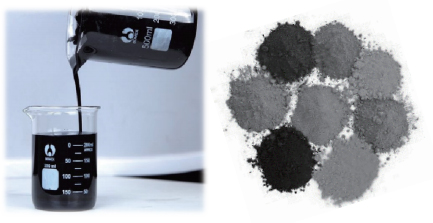
Battery slurry is obtained by evenly mixing liquid medium with positive and negative electrode active materials, conductive agent and binder, and then coated on the current collector, and the solvent (water or NMP) is removed by drying and baking. The various characteristic parameters of the slurry are the basis for measuring the slurry, and the conductivity of the slurry is an important parameter that determines the conductivity of the battery cell.
 | Raw material control Particle size distribution, particle morphology Wettability, suspension Molecular configuration, impurity content | Recipe Control Good dispersibility, particles do not agglomerate Good adsorption strength, no shearing Fast adsorption speed | Process Control Emulsification average conditions Sol temperature Stirring speed |
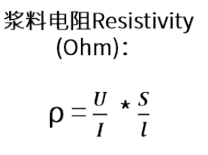
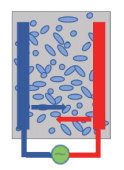
The slurry resistance meter is based on the AC Ohm's law, adopts an innovative measuring cup design and is equipped with a fully closed-loop intelligent testing system. By setting a counter electrode on the inner wall of the cup, a closed loop is formed with the slurry to detect the electrical properties of the slurry.
Calculation formula:
|
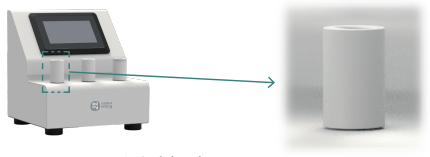
Test cup real picture | ||
Measuring cup No. 1 |
Measuring cup No. 1 |
Measuring cup No. 1 | |
Test cup diagram | |||
New perspective The first measurement of new parameters of slurry conductivity The first evaluation of slurry stability through conductivity fluctuations | Exclusive cup electrode Creative electrode cup concept, measuring electrodes are simple and easy to clean Three-electrode cup application realizes synchronous sedimentation monitoring of slurry samples in multiple areas | Online detection Customized online testing solutions One-stop collection of key parameters such as anode rate and temperature | Multi-region synchronization Single point mode and linear mode of slurry characteristics are optional Multi-dimensional data correlation prediction analysis |
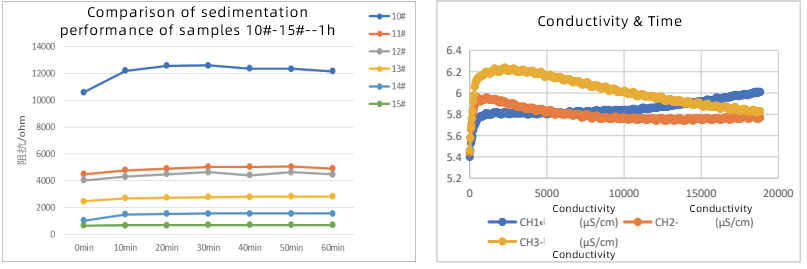
1. Evaluation of battery slurry sedimentation performance and conductivity |
·The sedimentation performance of different types of slurries varies. The straighter the test result curve of each sample, the more evenly the slurry is mixed, and the worse the sedimentation effect;
·Over time, the conductivity of the upper slurry gradually increases, and the conductive performance is enhanced. The conductivity of the middle and lower layers gradually decreases, the values gradually approach, and the conductive performance weakens.
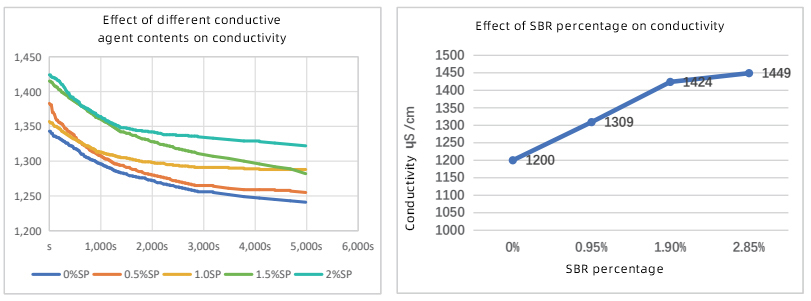
2. Resistance monitoring of pastes with different conductive agent and binder contents |
·The higher the content of conductive agent, the better the conductivity. The conductivity of slurry increases with the increase of binder.
·Evaluate the effect of different binder and conductive agent contents on slurry conductivity and improve the conductivity of the formula.
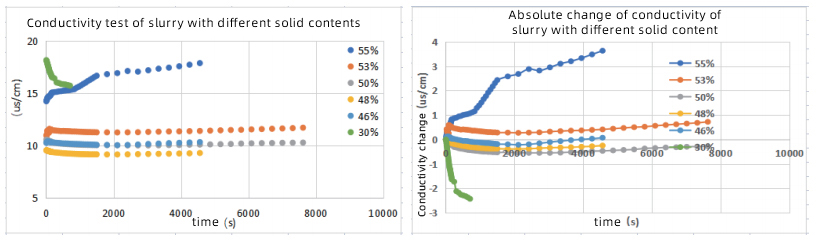
3. Evaluation of Resistivity of Slurries with Different Solid Contents: LFP |
·The optimal solid content process range of LFP: 46%-53%;
·Determine the suitable solid content of a specific formula slurry; when the solid content exceeds a certain limit, the sedimentation performance of the slurry will show the opposite characteristics.
4. Negative electrode slurry stability assessment |
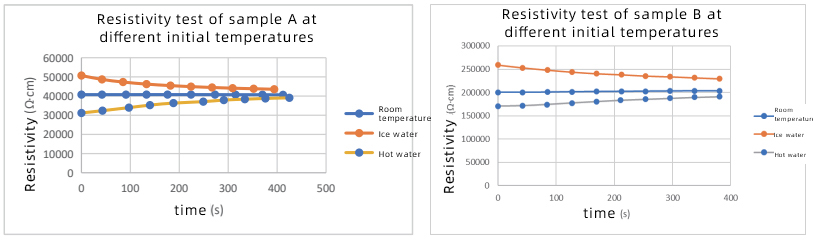
·After samples A&B were placed at room temperature and slowly stirred for 30 minutes, the resistivity did not change significantly over time; after being kept in ice water (0°C) for 1 hour, the resistivity increased significantly compared with room temperature, and as the slurry temperature rose over time, the resistivity decreased; after being kept in hot water (>50°C) for 1 hour, the resistivity decreased significantly compared with room temperature, and as the slurry temperature dropped over time, the resistivity increased.