






 【关注川源科技HiCY】
-

 服务热线 400-700-2017
服务热线 400-700-2017
服务热线 400-700-2017
搜索更多信息

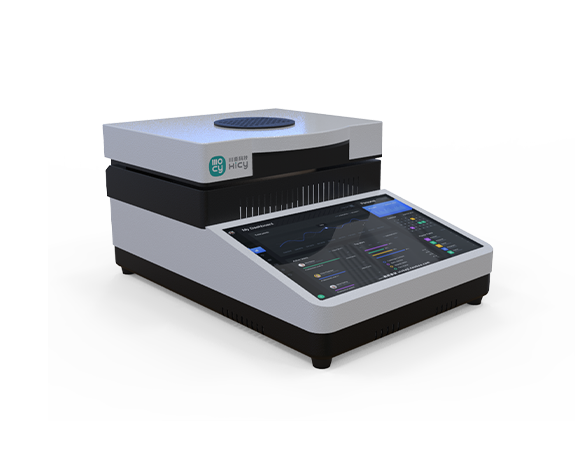


We are committed to solving the problems of low efficiency and large errors in the traditional oven method, and optimizing the electrode slurry ratio and process stability through real-time and accurate solid content detection.
Application Areas

·Material development evaluation
Compare the solid content level of the slurry under different formulas to optimize the material system
·Process stability monitoring
Determine whether the slurry is within the coating window
·Process development
Verify the impact of different pulping processes
High accuracy (0.01%) |
Dynamic temperature control |
Rapid Testing |
Smart Data Management |
Multi-mode drying |
Modular maintenance |
Model | AF-S200 |
Test Principle | Thermal Radiation Vision |
Test Beat | 15 seconds a set of data |
Test temperature | 200~480℃ |
Test conditions | ·Mould diameter: 10*10cm |
Measurable parameters | Isolation membrane pore volume, pore rate, thermal stability coefficient, etc. |
Applicable samples | Diaphragm |
Motion Motor | Servo Motor |
Features | ·Precise temperature control, micron-level motion-controlled hole generation ·Visual intelligent analysis, instant capture of hole size ·Multiple security protections, automated and efficient testing ·Multiple account login permission settings. Fully automatic measurement software |
Equipment size (L*W*H, mm) | 300*310*340 |
Equipment weight (kg) | 20 |
Power(W) | 400 |
Slurry solid content is the core indicator of lithium-ion battery electrode slurry composition, which directly determines coating uniformity, electrode porosity, battery energy density and safety. The traditional oven method is difficult to meet the needs of large-scale production due to its low efficiency and large errors. The new generation of detection technology achieves real-time monitoring through efficient automation and precise temperature control, and comprehensively optimizes the manufacturing process.
Electrode level ·Slurry rheology ·Electrode sheet porosity ·Electrode mechanical strength ·Active material distribution Lithium battery level ·Energy density ·Cycle life ·Rate performance ·Safety | Traditional oven method | HiCY Innovation Solution |
It takes 4-6 hours, and there is no real-time feedback | 10-minute rapid detection, supporting production line monitoring | |
Manual weighing error>1% | 0.01% resolution, fully automatic calibration with zero error | |
Open drying, solvent volatilization pollutes the environment | Closed drying, directional waste gas recovery | |
Single temperature can easily destroy active substances | Dynamic temperature control algorithm, 50~200°C precise adaptation |
·Loss on drying method
·The water or other volatile components in the sample are removed by heating, the mass change before and after drying is measured, and the percentage of solid matter in the total mass (i.e. solid content) is calculated.

High-precision detection New mass sensor Solid resolution up to 0.01% Mass accuracy 0.001g | Efficient and flexible Halogen tube 400W fast heating Detection speed increased by 80% Supports multi-mode drying of high viscosity slurries such as NCM/LFP | Intelligent operation 10 preset programs with one-touch call LCD screen graphic guidance 100 sets of data storage and support for LIMS docking | Modular design Weighing/drying unit is removable for maintenance Adapts to 95mm sample tray |
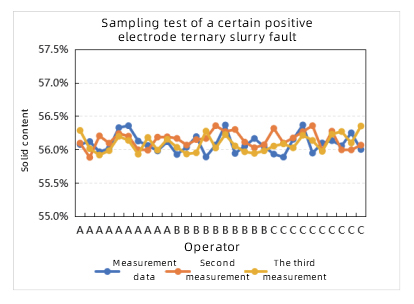
1. Sampling detection of positive electrode ternary slurry failure ·The solid content of the ternary slurry prepared in the same way was tested by continuous sampling: The average value was 56.09%, and the relative standard deviation was 0.25%.
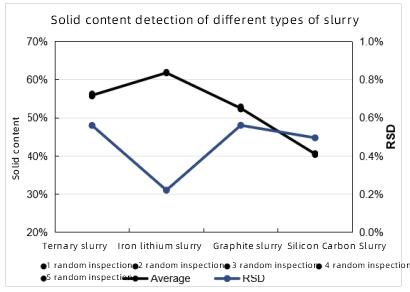
| 2. Solid content detection of different types of slurry ·Each slurry was sampled 5 times to test the solid content of the slurry: The solid content of the ternary slurry was 55.90%, and the relative standard deviation was 0.56%.
|